


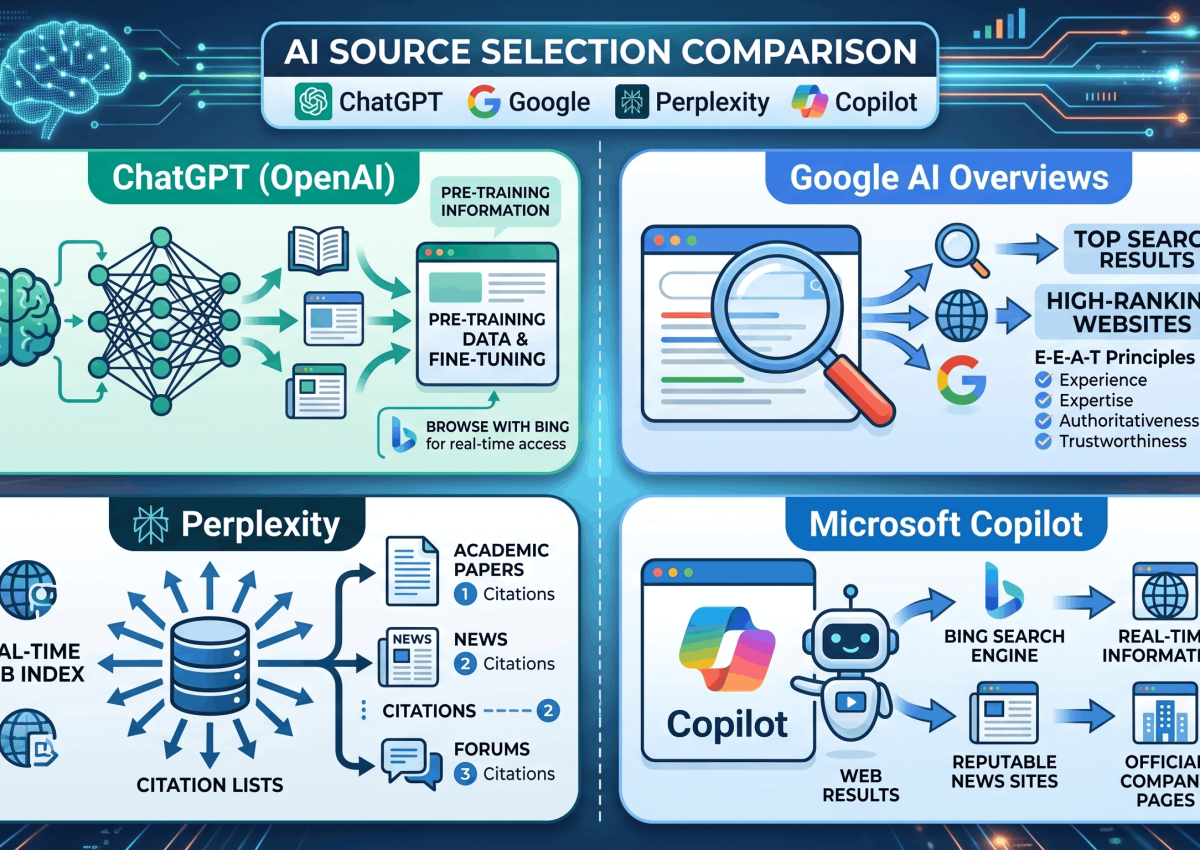
Thinking that being cited in one AI would make you automatically be considered for all platforms is far from the reality of how these work. Every conversational ai platform available on the internet has their own idiosyncratic approach in selecting references, akin to four different judges judging the same talent show in entirely different ways.
Learning about the source selection criteria of AI in relation to ChatGPT, Google AI Overviews, Perplexity, and Microsoft Copilot is arguably the most important lesson that a business can gain in the year 2026. Let’s look at each one without getting lost in complicated terms.
Why AI Platforms Behave So Differently
Every single AI system has its unique technological foundation, draws from unique sources, and actually has unique preferences when it comes to an ideal answer. While some of them work with real-time web crawling, some are highly dependent on training data sets, while some use both approaches.
That is precisely the reason why being on top of one AI-powered platform does not mean you will have similar results on the other. It is proven by data from citation studies, which proves that the overlap between domains that are cited in ChatGPT and Perplexity is minimal, meaning that those two AI systems judge content according to very different criteria.
This means that companies that want to increase AI search visibility cannot afford using just one-size-fits-all approach to their content creation anymore.
- Different information retrieval systems used in different platforms
- Different preferences regarding source type among platforms
- Different citation styles and referencing preferences
- Different sensitivity to freshness of your content
How ChatGPT Sources Information
The references used by ChatGPT also usually have a very heavy inclination towards popular content. The research carried out on ChatGPT citations showed that Wikipedia appears extremely frequently among the highly cited domains, implying that the platform prefers well-established, widely-recognized sources over niche and untrustworthy pages.
The ChatGPT citations, however, can also be somewhat selective compared to other platforms and typically cite fewer sources per response but a relatively diverse range of domains in total. This implies that being referred to by credible third-party websites instead of only the user’s website is significant.
Implications for Your Content
To gain better visibility on ChatGPT, being mentioned by reputable industry publications or information websites will also work as effectively as improving the website content.
Writing which is clear and factual but resembles an encyclopedia article rather than a marketing pitch fits perfectly with this platform.
How Google AI Overviews Ranks Content
Google AI Overview ranking factors differ from what people think. Most people believe that being ranked first in conventional Google search will guarantee being listed in AI Overview boxes, however, the link between the two seems to be fading. The technology of Google AI depends on the process where passages are extracted and rated and not just the high-ranking pages pulled.
Now semantic completeness, structured data, and E-E-A-T signals play a significant part in Google AI Overviews in comparison with conventional keyword rankings only. A page may have low ranking traditionally but still be listed in AI Overview because certain passage contains direct answer to a particular question.
It is extremely important for Answer Engine Optimization (AEO) and Generative Engine Optimization (GEO) strategies because they reward quality content structure, and not the old-fashioned keyword stuffing.
- Structure your content with clear question-matching headings
- Utilize schema markup for passages extraction
- Create real authority signals on your website
- Update your content and do not leave it outdated for years
How Perplexity AI Chooses Its Sources
However, Perplexity AI differs from ChatGPT significantly in that it conducts real-time web searches on almost all queries rather than depending primarily on training data. This results in a very high responsiveness to fresh material, citing material published just a few weeks ago more often than older material.
Citations by Perplexity AI also utilize community platforms more actively compared to any other search engine because discussions in the real world are seen by this tool as an important signal alongside traditional sources. In short, being a part of the discussion is what matters here, not just publishing and waiting for people to find out about it.
Your brand may be underrepresented in relevant online discussions, which will result in low visibility on the Perplexity search engine without you noticing it.
- Frequent publication and updates of the content for freshness signals
- Active participation in online discussions related to your brand
- Use of dates and structural formatting of the content
- Answers provided directly and with sufficient support
How Microsoft Copilot Search Works
Copilot search from Microsoft uses a Bing-powered platform integrated with AI. When compared to Perplexity, Copilot seems to use fewer sources in each answer and relies on the combination of reliable authority indicators and structured data.
Microsoft itself openly stated that schema markup is important for their models to understand web content properly. It is safe to say that companies relying on structured data speak the language that Copilot understands.
A Few Words about Structured Data
The clean structured schema is not useful only for Copilot. It helps your visibility on almost any AI SEO activity you do, as machines seem to love clearly marked-up content.
Companies who choose to neglect structured data just force these engines to analyze the information harder, and slower engines simply go for an easier target.
Comparing AI Search Ranking Across Platforms
A comparison of search ranking for AI reveals this quite clearly – ChatGPT prefers to use consensus and references; Google AI Overviews likes to use structured, extractable passages without considering traditional rankings; Perplexity prefers freshness and community contributions; and Copilot relies on structured authority via Bing.
It is because of this that generative AI search should not be viewed as one technique alone. A well-planned GEO campaign will always be aligned with the specific preferences of each platform rather than assumptions based on traditional SEO techniques.
Building an AI Citation Sources Strategy
Given that there are many different AI citation platforms, the business should have a slightly complex strategy. This will involve having quality on site material, structured data, and third party mentions.
It does not help to try to do everything on all of the platforms equally because you will end up doing an average job on all of them rather than doing well on any of them.
How Gettech Infinite Helps With AI Search Optimization
Gettech Infinite can show companies precisely how search results for an LLM differ on ChatGPT, Google AI, Perplexity, and Copilot, and then develop a strategy for each system that accounts for its unique likes and dislikes rather than using a universal strategy.
Whether it is implementing schema markup or developing approaches to make information fresh and visible to third parties, our team will pay attention to those actions that would actually improve AI search visibility on various platforms.
Final Thoughts
AI platforms are not a monolithic audience; they are four separate entities with four different tastes as for a reliable source. This understanding is becoming one of the key aspects of any AI SEO strategy in 2026.
In case your content strategy doesn’t differentiate between AI platforms, you should think about changing that before your competitors start doing it.